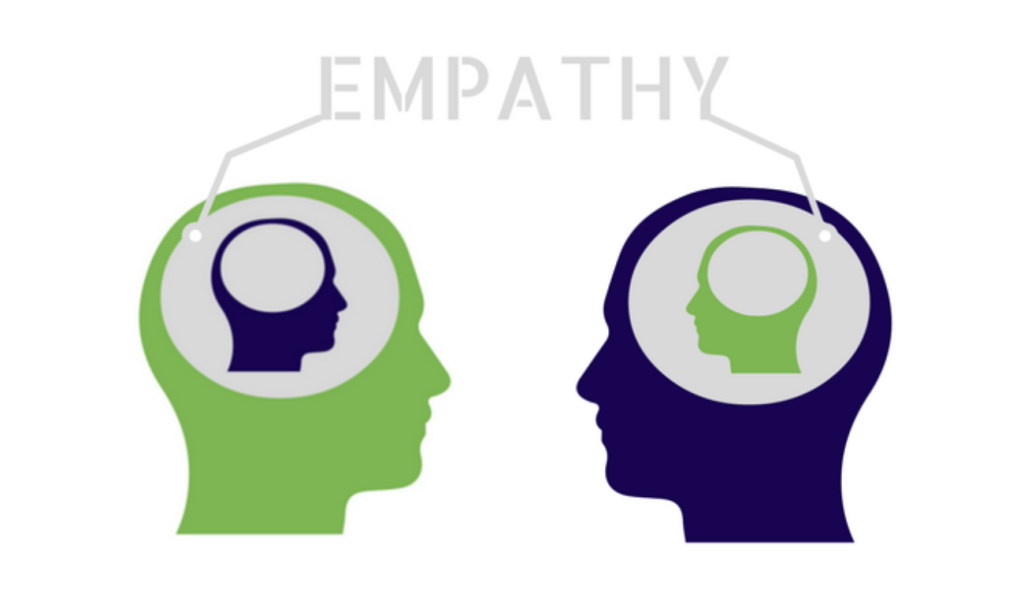
How do you truly understand your customer’s perspectives, feelings, and needs, in order to design an experience for them that meets their goals? (Wiecek, 2018). The first step is tapping into your biological sense of empathy and putting yourself in the customer’s shoes. “Empathy is deeply human-centric and is essential at the start of any design process” (Dam and Siang, 2024). Simply asking customers for feedback is one step but delving further into their actions, feelings, and thoughts can give designers much more insightful information.
Empathy is defined as “our ability to see the world through other people’s eyes — to see what they see, feel what they feel and experience things as they do” (Dam and Siang, 2024). It helps you read between the lines and truly understand users’ needs, which is important for building a successful product or service. Using intuition and extracting the thoughts behind what users say is an integral part of the success. Although some people have stronger intuitions and feelings of empathy than others, there are many exercises involved in eliciting the true thoughts, needs, and desires of users.
In “Empathy on the Edge”, Katja Battarby points out the importance of empathy in business and how it may be challenging for some workers. Workers and creators may have the most creative and intelligent skills, but if they are unable to set aside their own role or status, they cannot put themselves in the mindset of the user (Battarby, 3). For instance, one technique exploring empathy in developing a product for children might be crawling around with them on the floor to see things through their perspective. If workers do not have a safe environment free of statuses and egos, the design process may not be successful.
In addition, incorporating empathy into the development process earlier helps ensure that the product or service is most successful for the user. Frederick Leichter, the chief customer experience officer at Fidelity Investments says, “rather than developing and then testing, we now begin projects with customers, to incorporate their thinking earlier and more effectively” (Kelley, 2013).
Empathy Maps
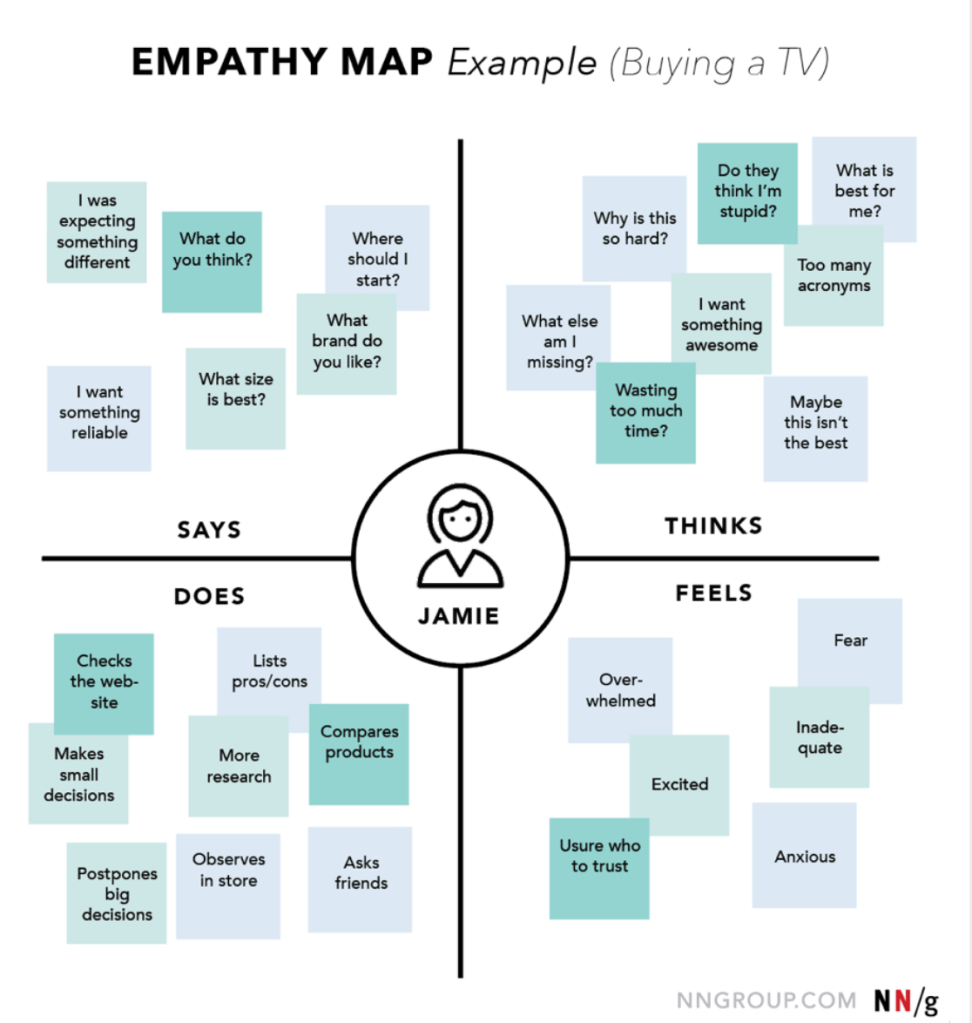
There are many tools and techniques used to tap into users’ perspectives and gather information using empathy. Empathy maps are one of the tools used throughout the design thinking process. They can be beneficial in identifying who the users are more closely and gathering information all in one place to determine what the users are saying, doing, thinking, and feeling. For example, the empathy map below describes all of the information gathered on a user’s process in purchasing a TV. Not only are the user’s statements involved, but the actions, thoughts and feelings behind the statements are also included (Gibbons, 2018).
What/How/Why Method
One method that is commonly used at the beginning of a design thinking research process is called the What/How/Why Method. This is a great technique that involves observation and breaking down the motivation behind the user’s actions. For example, if you were studying the best method of signing into a doctors office, you could start with this method. Observing a patient sign into a doctor’s office waiting room is the “what”. Asking how they sign in whether it is on a kiosk, verbally or on paper is the “how”. Then, asking “why” a patient chose to write his private information down instead of saying it out loud is the last step. This would give healthcare professionals some insight to what method works best for the patient.
Love Letter/Breakup Information
Another method is the love letter/breakup information method that involves creating a personal letter written to a product that can reveal new insights about what people value and expect from the objects and services in their everyday life (Wiecek, 2018). This can be done by customers or stakeholders and starts with writing a love letter and a breakup letter that can reveal what the customer values and expects from a product or service. The passion in the love letter or distain in the break up letter can reveal more details about what the user values or is turned off by.
Empathic interviews & The Five Whys method
Empathic interviews & the five whys method is another technique used to gather deeper understanding of the users motivations and thoughts behind their statements or actions. This involves a traditional one-on-one interviews but taking them a step further and asking at least five “why” questions as a followup for each answer. For instance, you might ask a customer “why haven’t you returned to eat at a restaurant again?” When you get the answer, go deeper into asking “why didn’t you like the menu” or “why did you think the food was boring”.
The above examples are just a few of the techniques you can use to put yourself into the user’s mindset. Some methods involve speaking to users about their feelings and some involve making yourself the user to identify what you felt. Different techniques work for different products and services. However, all of the techniques are ways to get more information from the most valuable source…the person or group who will be using your product or service. You may have the most innovative designers on your team, but without empathy and truly understanding the user, some of the most complex problems and roadblocks may never even be discovered or solved.
Citations:
Battarbee, K., Suri, J. F., & Howard, S. G. (n.d.). Empathy on the edge – ideo- Janury 9 2014 – empathy on the edge scaling and sustaining a human-centered approach in the evolving practice of design by: Course hero. Empathy on the Edge – IDEO- Janury 9 2014 – https://www.coursehero.com/file/13347889/Empathy-on-the-Edge-IDEO-Janury-9-2014/
Kelley, T., & Kelley, D. (2013, November 8). Designing better online banking for millennials. Slate Magazine. https://slate.com/human-interest/2013/11/empathize-with-your-end-user-creative-confidence-by-tom-and-david-kelley.html
Dam, R. F., & Siang, T. Y. (2024, September 6). What is empathy and why is it so important in design thinking?. The Interaction Design Foundation. https://www.interaction-design.org/literature/article/design-thinking-getting-started-with-empathy
Gibbons, S. (2024, January 24). Empathy mapping: The first step in design thinking. Nielsen Norman Group. https://www.nngroup.com/articles/empathy-mapping/
Wiecek, A. (2018, August 13). 9 best empathic research methods to help you dig deeper & truly understand your customer. Medium. https://medium.com/@alewiecek/9-best-empathic-research-methods-to-help-you-dig-deeper-truly-understand-your-customer-5a9b56c45e59
 Becca Gottlieb Creative
Leave a comment