When someone asks you how you came up with an idea or solution, it doesn’t always come down to a lightbulb on top of your head. There are actually many techniques on ideation including the newly-popular design sprints. A design sprint is an “intense, focused process in which a small team designs and tests a solution to a big design challenge” (Stevens, 2023). They can usually last five days with a team of people but can be done in a shorter or longer amount of time depending on the challenge.
As an example, I interviewed Melanie Henshaw, a student at Quinnipiac University on her experience at the school and how it could be improved. I interviewed her, identified one problem, then went through a series of steps to ideate on solutions. At the start, I did not think there were that many tangible solutions, but after the process, I was surprised at the amount of ideas and number of solutions I explored. Below are the basic steps involved in a typical design sprint:
Step 1: Define
One of the most important parts of determining your solution is identifying the problem by using empathy. “Empathy is crucial to problem solving and a human-centered design process as it allows design thinkers to set aside their own assumptions about the world and gain real insight into users and their needs” (Dam, 2024). By interviewing Melanie on her experience as a student, I was able to take detailed notes and dig deeper into any issues or roadblocks she encountered in her experience. I explored her needs and insights and found that she was having difficulties with the financial department of the school.
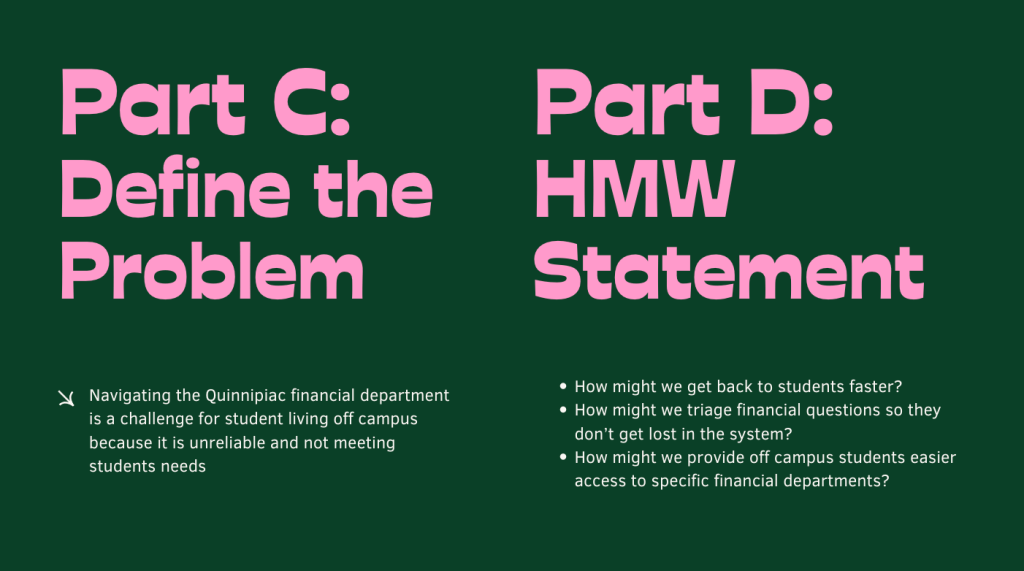
Melanie was unable to get the financial department to return her calls, emails, or direct her to the right person to answer her financial aid questions. I ended up defining the problem as “navigating the financial department is a challenge for students living off campus because it is unreliable and not meeting students’ needs”. In addition, using a “how might we” statement to define the problem helps elicit empathy to put yourself into the shoes of the group seeking a solution. See “how might we” statements we came up with below:
Step 2: Ideate
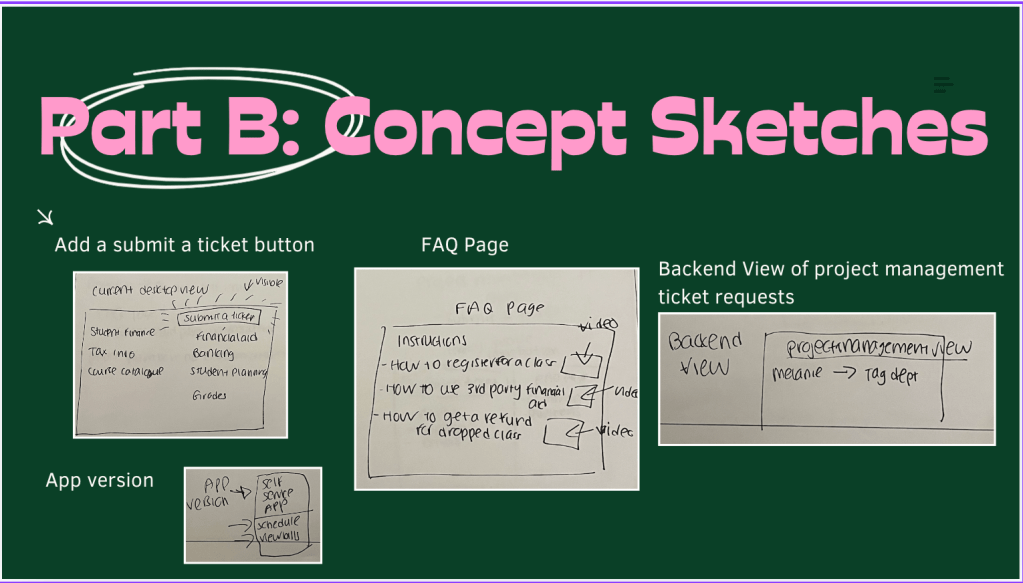
The ideation phase is the next step in taking action to find a solution after defining the problem. By using lightning demos, I researched online for inspiration to find examples of how others have approached similar issues. I came across some project management apps such as Monday.com and Asana that gave me an idea to use a project management ticket system to field multiple student requests. I also thought that an FAQ page with instructional videos to help answer general financial questions would also help.
I continued the ideation stage by sketching any ideas that came to mind. I used the “how about we” statement and lightning demo ideas to sketch out what an ideal solution would be. Keeping in mind there are no wrong answers in this stage and some of the most creative solutions come from an environment where the wildest ideas are thrown out. Some examples of my fast and basic sketches are below:
Step 3: Decide
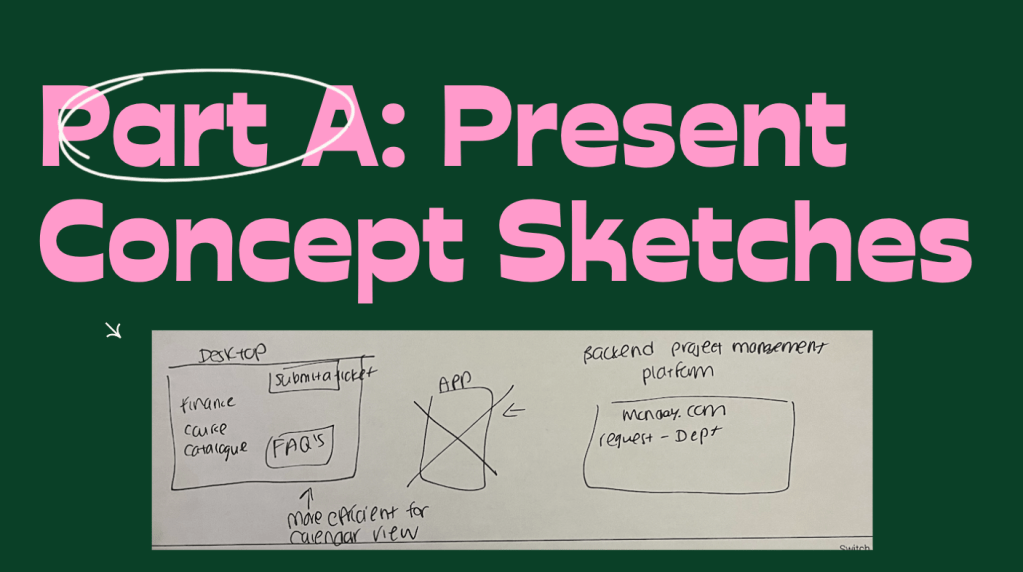
The next step involves presenting concepts to the group, capturing feedback, and reflecting on that feedback. Going back to your sketches and ideas and using your team to build on them or eliminate them is essential to find the best solution. Redefining your concepts based on constructive feedback is a great path to find what works and what doesn’t work. For example, my team realized that a desktop website would work better than an app and a project management platform would work really well for students and the financial department. See the example sketches below:
Step 4: Prototype
Prototyping is the step where you actually build your solutions. When I say build, I mean create any type of solution using pencils, markers, clay, collages, legos, etc. It is important to note that prototypes are not finished products. In fact, they are far from it. The design thinker, Tim Brown says, “the goal of prototyping isn’t to finish. It is to learn about the strengths and weaknesses of the ideas and to identify new directions that further prototypes might take” (Brown, 87). An example of my prototype of the Quinnipiac website (that is far from a finished product) is below. You can see the website along with where each button would click out.

Step 5: Test
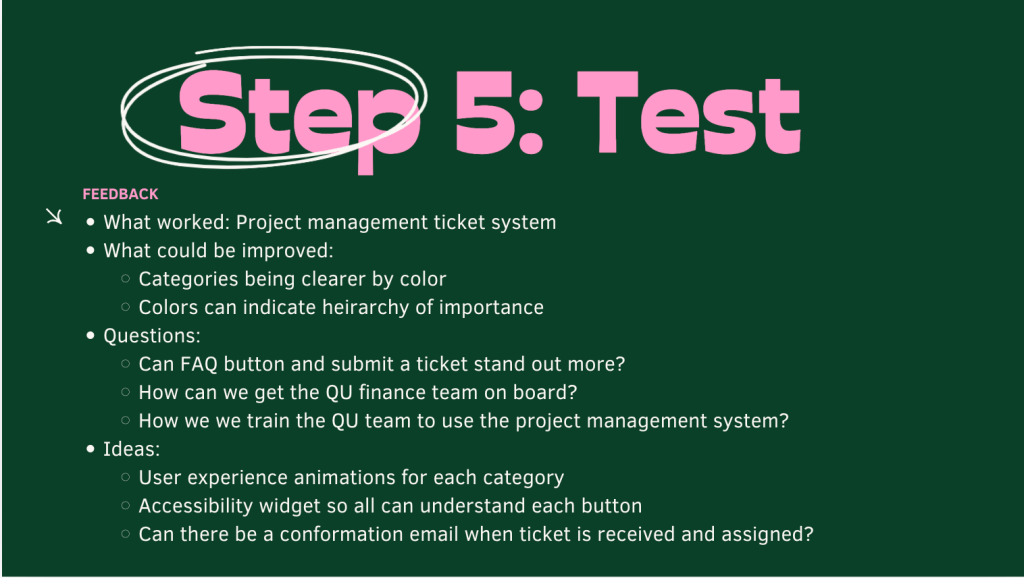
The final step in the design sprint process is testing your prototype. Presenting your prototype and testing it is a crucial part of the process to see what worked and what did not work. Feedback is beneficial in determining what could be improved and asking additional questions helps to identify all solutions and perspectives. The feedback and questions that my team identified are below. For instance, thinking about how the financial team would be trained on the new project management system would take some strategy. In addition, some feedback included having the project management system provide notifications when each request is being worked on so the student is aware of the status of their request.
After the full design sprint process, I was pleasantly surprised at the amount of ideas that I came up with in such a short amount of time. I thought that working with someone or a team was extremely helpful to bounce ideas, questions, and solutions off of. It was also productive to have a team that helped grow each idea and help spark new ideas from throwing out any idea that came to mind.
Finally, I thought that the feedback and questions part of the design sprint was particularly important to get different perspectives on unforeseen complications. The structure was helpful, even though the order can be altered and non-linear in accordance with different cases. Overall, I would use this technique again as a great place to start whenever I have a problem that needs an immediate solution with a trustworthy and creative team.
Click HERE to see the entire design sprint process in more detail.
Citations:
Brown, T. (2020, October 22). Design thinking. Harvard Business Review. https://hbr.org/2008/06/design-thinking
Dam, R. F. (2024, August 24). The 5 stages in the design thinking process. The Interaction Design Foundation. https://www.interaction-design.org/literature/article/5-stages-in-the-design-thinking-process
Stevens, E. (2023b, January 16). How do design sprints work in UX?. UX Design Institute. https://www.uxdesigninstitute.com/blog/how-do-design-sprints-ux/
 Becca Gottlieb Creative
Leave a comment