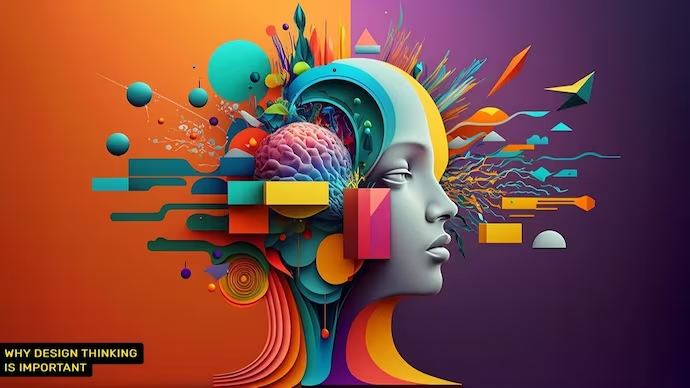
When the term “critical thinking” is used, it is often associated as an enrichment exercise from a grade school textbook where you analyzed a problem and applied knowledge to come up with a solution. The process of critical thinking is now outdated and a much more successful type of thinking is taking its place. Design thinking is a new type of thinking that matches people’s needs with what is possible through technology and viable business strategies that can convert into increased customer value (Brown, 86).
In the “Sciences of the Artificial”, Herbert Simon says, “Unlike critical thinking, which is a process of analysis and is associated with the ‘breaking down’ of ideas, design thinking is a creative process based around the ‘building up’ of ideas” (Simon, 55). The possibilities in design thinking are endless since it is based on a process that encourages maximum input and participation without any judgement. It creates safe, exploratory environment where any and all ideas are encouraged and often lead to the most creative solutions. (Fast Company, 2006).
Where to Begin
The simple place to start is with the consumer or the audience that is using your product or service. They are your most valuable source of information because this audience is using your product or service regularly and has first-hand experience with its function. The most fundamental skill for design thinking is empathy. Putting yourself in the shoes of your audience can give you a “people-first approach” where you can put yourself in their shoes and imagine solutions that are desirable and meet immediate needs of the consumer (Rice, 87).
The process always involves defining a problem and bringing in teams to work together. By involving many team members, you can widen your perspective to have a multi-level approach to creating more solutions. Even if the solution may be obvious, more solutions are always more valuable because “looking at a problem from more than one perspective always yields richer results” (Fast Company, 2006). Ideally, multiple ideas are able to be freely thrown out into the group and then can be built upon by multiple thinkers.
The Process
Hasso Plattner Institute of Design at Stanford defined the five stages of design thinking below (Dam 2024):
Stage 1: Empathize—Research Your Users’ Needs – Empathy is a crucial starting point and allows design thinkers to see multiple sides of a situation and gain insight into users and their needs.
Stage 2: Define—State Your Users’ Needs and Problems – Defining the problem from a human-centered perspective is key here. Using the point of view of the user creates a clearer perspective to directly respond to the users’ needs.
Stage 3: Ideate—Challenge Assumptions and Create Ideas – There are many techniques for ideation such as “worst possible idea” or SCAMPER, but the most important factor is creating a safe space for a team to throw out any idea, no matter how wild it may seem.
Stage 4: Prototype—Start to Create Solutions – This is an experimental phase that tries to identify the best possible solutions for each problem defined in stage 2. It is important to note that prototypes do not have to be finished products and some of the most successful prototypes come from the simplest versions easily accessible by all.
Stage 5: Test—Try Your Solutions Out – Testing out the product or service is the final phase where you can to see how successful it is and listen to your audiences’ reactions.
Examples of Success
For instance, Kaiser performed a study on how to improve patient and medical practitioners experience in their hospitals. Using the first step of empathy and connecting with the nurses who were actually on the ground during shift changes, they were able to identify a problem and the increasing amount of time it took nurses to transfer patient information during shift changes. A team of design thinkers ideated on multiple solutions and created prototypes for the most successful solutions. They created portable nurses stations where they could record patient data in patient rooms and transfer information to nurses more easily on a shared notes platform.
Through this prototype, they learned that a new software could pull up previous shift notes and easily add patient notes that would be customized for each new nurse on their shift to majorly cut shift transition time. Through testing, they learned that this provided better informed contact with patients and more accurate information passed on from shift to shift. This solution, in turn, created more accurate care and a higher amount of trust between patients and their providers (Rice, 86).
A Non-Linear Technique
When following Plattner’s steps, one important point to note is that they do not have to be carried out in a linear pattern. The design thinking process is actually more successful when carried out in a non-linear fashion. For instance, some projects may require an immediate prototype and then require the team to go back to the ideation phase for a more successful version. The most important fact is that there are many ideas being created and tested in order to find the most successful solution. Although critical thinking may have been the first of its kind, design thinking is the way forward to create the most creative innovations and solutions.
Citations:
Brown, T. (2020, October 22). Design thinking. Harvard Business Review. https://hbr.org/2008/06/design-thinking
Dam, R. F. (2024, August 24). The 5 stages in the design thinking process. The Interaction Design Foundation. https://www.interaction-design.org/literature/article/5-stages-in-the-design-thinking-process
India Today. (2023, July 13). Why design thinking is important in today’s job industries. India Today. https://www.indiatoday.in/education-today/jobs-and-careers/story/why-design-thinking-is-important-in-todays-job-industries-2406049-2023-07-13
Simon, H. (1969, June 18). The sciences of the artificial. MIT Press. https://mitpress.mit.edu/9780262691918/the-sciences-of-the-artificial/
What is design thinking and why is it popular? (2006, March 20). https://www.fastcompany.com/919258/design-thinking-what
 Becca Gottlieb Creative
Leave a comment